History
...............................................................
Secularization
Upheavels following the French Revolution entailed the political reorganization
of Europe. This was effected by the secularization in 1803. Ecclesiatical
property was confiscated, abbeys and monasteries were expropriated and
the religious communities disbanded. The sisters of Holy Cross Monastery
who could not foresee how things would develop, had already packed their
belongings, 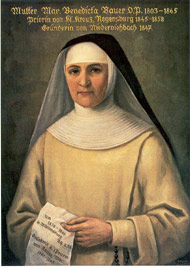 burnt
many books including the chronicle, and divided among themselves whatever
money was available. The year before a commissar had come to the monastery
and had proposed to each individual sister the option of remaining in
the monastery or of accepting a pension and returning to the world. All
the sisters had declared that they would not think of leaving the monastery.
When the new sovereign, Carl Theodor von Dalberg, also became responsible
for the spiritual direction of the bishopric, he extended a protective
hand over the monastery. However, he obliged the sisters to establish
a school for girls that they would have to teach in quarters that the
monastery had to provide. After a short preparation for their new responsibility
three sisters started as teachers. The school developed well. In 1870
the city of Regensburg built a school-house that was completed in 1872.
At this time ten sisters were involved in teaching.
burnt
many books including the chronicle, and divided among themselves whatever
money was available. The year before a commissar had come to the monastery
and had proposed to each individual sister the option of remaining in
the monastery or of accepting a pension and returning to the world. All
the sisters had declared that they would not think of leaving the monastery.
When the new sovereign, Carl Theodor von Dalberg, also became responsible
for the spiritual direction of the bishopric, he extended a protective
hand over the monastery. However, he obliged the sisters to establish
a school for girls that they would have to teach in quarters that the
monastery had to provide. After a short preparation for their new responsibility
three sisters started as teachers. The school developed well. In 1870
the city of Regensburg built a school-house that was completed in 1872.
At this time ten sisters were involved in teaching.
In 1847 Mother Benedicta Bauer, presumably the most famous prioress of
Holy Cross, established a community in Niederviehbach commissioned to
teach girls of the middle-class that became independant in 1863, and in
the 1850s she sent several sisters to the United States where teachers
for the German immigrants' children were needed. Finally she left too.
Soon numerous congregations tracing their origin to Regensburg came into
being.